

Fundraising Deep Tech Startups of BHARAT
Col Manik Anandh (Veteran)
4/23/20264 min read
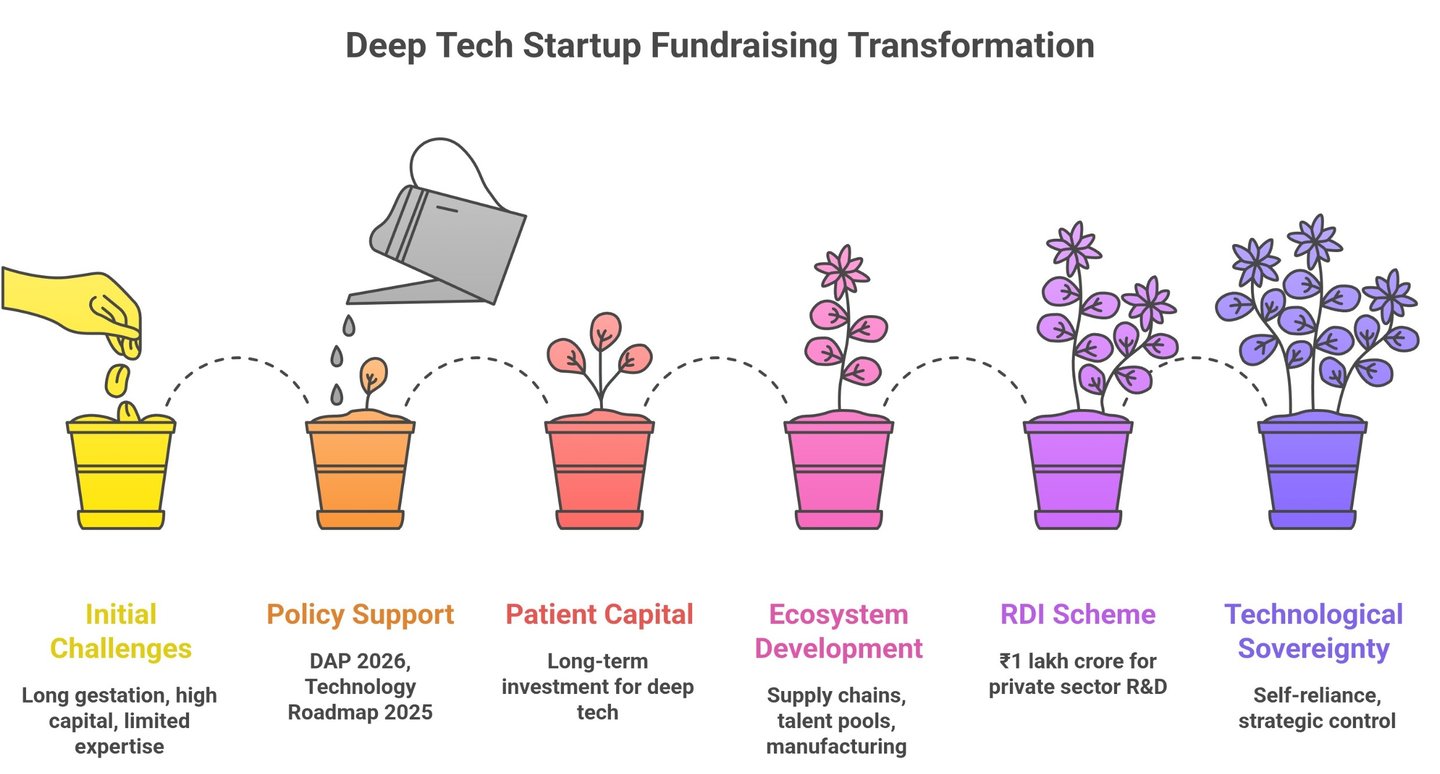
The intent towards Bharat’s push towards and owning core technologies locally has been clearly stated in the Draft DAP 2026 which was put in the open domain for comments & which will be approved shortly. This has now opened up a powerful opportunity for deep tech startups and if implemented in letter & spirit “It’s game over for the ASSEMBLERS & JUGAAD entities”. Owning proprietary stacks of critical elements of deep tech with no back door room vulnerabilities is now a “ NATIONAL REQUIREMENT”. We need to bite this bullet of giving Domestic Defence Industry time & ensure “PATIENT CAPITAL”. The Technology Perspective Road Map 2025 has been shared with the industry & there is fair clarity for the industry what to develop & what the potential order book will be. From defence tech and drone mapping to semiconductor tooling and agri-tech infrastructure, founders are stepping into domains that were historically import-dependent.
But despite strong intent and growing policy support, startups working on deep tech face a very different fundraising landscape compared to typical SaaS or consumer ventures. The bottlenecks are not imaginary-they are structural, financial and sometimes cultural within investment ecosystem.
1. Long Gestation Periods vs. Investor Expectations
Most indigenisation-focused startups operate in deep-tech or hardware-heavy domains. These ventures require years of R&D, prototyping and validation before reaching commercial scale. In contrast, a large portion of Indian venture capital is optimised for:
Faster revenue cycles
Quick market validation
Scalable software-first models
This mismatch creates friction. Investors often hesitate when returns are not visible within a 3–5 year window, while indigenisation startups may need 7 years in certain cases a decade to fully mature.
2.High Capital Intensity Building indigenous tech solutions often means:
Setting up physical infrastructure
Investing in specialised hardware
Running iterative testing cycles
Maintaining compliance and certification processes
This leads to significantly higher upfront capital requirements compared to asset-light startups. For many investors, especially early-stage funds, this increases perceived risk. As a result, founders struggle to secure large enough seed rounds to meaningfully progress their technology.
3.Limited Deep-Tech Investment Expertise
Evaluating indigenisation startups requires domain-specific understanding-whether it's aerospace systems, geospatial pipelines or advanced materials. However
Many investors come from SaaS or fintech backgrounds
Technical due diligence capabilities are still evolving
Risk assessment frameworks are not always suited for deep-tech
This often results in underestimation of the startup’s potential or overestimation of its risks.
4.Market Validation Challenges Unlike consumer products, indigenisation startups often rely on:
Government procurement
Enterprise contracts
Strategic sector adoption
These markets have longer sales cycles and complex onboarding processes. From an investor’s perspective, this creates uncertainty:
Revenue pipelines are harder to predict
Early traction is slower to demonstrate
Customer acquisition doesn’t follow conventional metrics
5.Dependence on Ecosystem Readiness Indigenisation of critical technologies is rarely a standalone effort. Startups depend on:
Local supply chains
Skilled talent pools
Supporting manufacturing ecosystems
In many cases, these ecosystems are still developing. This creates execution risk, which investors factor into funding decisions.
6.Valuation Disconnect Founders developing deep-tech and indigenisation often build highly defensible intellectual property. However, because revenue may be delayed, valuations based on traditional metrics can appear conservative.
This leads to a gap:
Founders value long-term strategic importance
Investors focus on near-term financial indicators
Bridging this gap becomes a recurring negotiation challenge.
7.Exit Path Uncertainty Investors ultimately look for clear exit opportunities-IPOs, acquisitions, or secondary sales. For deep tech startups:
Strategic acquisitions are still limited
Public markets are cautious about early-stage deep-tech
Global buyers may take longer to engage
This uncertainty affects investor appetite, especially in early funding rounds.
8.Talent and Execution Constraints Building indigenous technology requires multidisciplinary teams-hardware, software, domain experts and regulatory specialists. However:
Such talent is limited and expensive
Teams take longer to assemble and stabilise
Execution timelines expand accordingly
This adds another layer of complexity to investor confidence.
Moving Forward
Despite these bottlenecks, the trajectory is shifting. There is increasing recognition that owning the levers of deep tech in “SOVEREIGN CONTROL” is not just a policy objective but a strategic necessity for long-term economic resilience. Department of Science & Technology (DST) has launched the Research, Development, and Innovation (RDI) Scheme, approved by the Union Cabinet on July 1, 2025. With a total outlay of ₹1 lakh crore, this transformative initiative aims to catalyse private sector participation in high-impact R&D. It aims to strengthen Bharat’s capabilities in strategic technologies and promote technological self-reliance, aligning with the nation’s long-term innovation and Atmanirbhar Bharat vision. Implementation Structure
Special Purpose Fund (SPF): Set up under the Anusandhan National Research Foundation (ANRF) to serve as the first-level custodian
Second-Level Fund Managers (SLFMs): May include Alternate Investment Funds (AIFs), Development Finance Institutions (DFIs), Non-Banking Financial Companies (NBFCs), or Focused Research Organizations (FROs) such as the Technology Development Board (TDB), Biotechnology Industry Research Assistance Council (BIRAC), IIT Research Parks, or similar entities
For startups, success often comes from:
Aligning with mission-driven capital
Leveraging grants and blended financing
Building early credibility through pilot deployments
Communicating long-term value clearly to investors
Fundraising in this space is undoubtedly harder, but for those who persist, the opportunity is equally significant. These startups are not just building companies; they are building capabilities that can redefine BHARAT’S TECHNOLOGICAL SOVEREIGNITY. We need one DISRUPTOR like ELON MUSK to show the way & for the FLOODGATES to open.
Note : It would be great if we could have feedback on the implementation of this system or any recommendations in respect of other schemes as regards the start ups operating in the Defence Domain or those building dual use technologies which can be used in the Defence Domain including SPACE. Feedback may be forwarded to director@pramanikaerospace.com
The next blog will cover a proposal for a New Grants Scheme Dedicated to Space Tech Startups. Stay Tuned
JAI HIND
Address
H.IN.KH.NO 293 S/F WESTERN MARG SAIDULAJAB, NEW DELHI, NEAR KHER SINGH ESTATE, DELHI 110030
© 2026 PRAMANIK AEROSPACE AND DEFENCE LLP. All Rights Reserved.
Website designed by Saikat Banerjee & Col Manik Anandh (Veteran)