


Maritime Domain Awareness & Blue Economy
Col. Manik Anandh
and
Cmde. Jasdeep S.Dhanoa

Draft DAP 2026 Explained: What Changes for India's Defence Startups?

DRONATHON at POKHRAN FIELD FIRING RANGES 14-16 Sep 26


Space Pivot to National Security Col Manik Anandh
in Conversation with
Lt Gen P. J. S. Pannu
asymmetric DefTech Podcast


Podcast with Defence Reimagined Channel hosted by Shivam Arya on Draft Defence Acquisition Procedure 2026


TALK & BRAIN STORMING SESSION WITH OFFICERS OF FUTURE WARFARE COURSE 4 ON PROCUREMENT NUANCES & OPPORTUNITIES For START UPs, MSMEs
VS
PRIVATE INDUSTRIES


The real conversation with Vaibhav Jain on Bharat's defence future, along with my professional journey


India’s Defence Transformation: Space & Geospatial for Strategic Autonomy WITH SAMARTH HANS

Most startups don’t fail because of lack of funding…
They fail because of lack of mentorship. Today, most founders are focused on:
• how to raise funding • how to reach investors • what valuation they’ll get
But the real question is: Are you fundable?
What mentorship actually does: A mentor doesn’t give you funding… A mentor makes you ready for FUNDING
Real role of a mentor:
• Clarifies your problem statement • Sharpens your solution • Validates your business model • Helps you build a strong pitch • Shows you where you’re going wrong
A mentor doesn’t give shortcuts… They give direction.
BIGGEST MISTAKE FOUNDERS MAKE
• Trying to figure everything alone • Executing without guidance • Ignoring feedback
And then blaming the market truth:
Right mentorship = faster growth + better decisions + higher funding chances
BEFORE CHASING FUNDING, ASK YOURSELF
• Is my business clear? • Is my model scalable ? • Can I answer investor questions confidently?
If not…You don’t need funding. You need mentorship.
Smart founders invest in mentorship first…
FUNDING FOLLOWS
WHY PRAMANIK










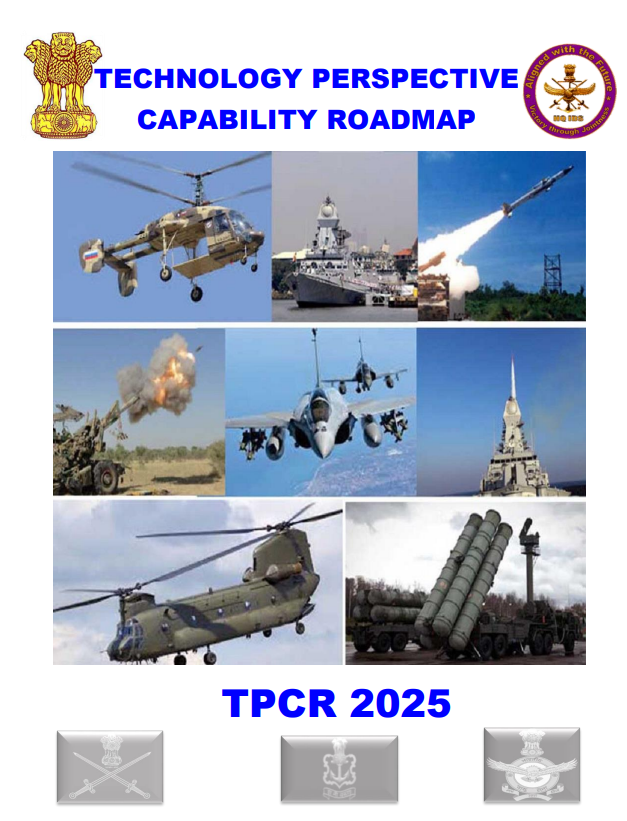
Technology Perspective and Capability Roadmap (TPCR) : Part 1 (22.04.2026)
RPA & SYSTEMS INDIAN ARMY
Technology Perspective and Capability Roadmap (TPCR) offers industry an insight into Armed Forces’ future capability requirements for next 15 years, influencing technology development. Industry is given an overview of equipment that is anticipated to be incorporated into Indian Armed Forces through end of 2030s by Technology Perspective and Capability Roadmap – 2025 (TPCR-2025). Goal of this document is to direct industry's potential path towards technological growth. Industry partners can use this roadmap as a guidance when organising or starting partnerships, production agreements and technology development.
TPCR has a structure with content that has inclusion of as much information as possible regarding quantity, life cycle, general criteria & preferred technologies. Sub-systems/ sub-sub systems/ sub-assembly/ part of any projects cannot be included, as TPCR is primarily required for easy identification of Technology envisaged for industry and such items shall form a part of RFP/RFI at time of contract
KEY REMOTELY PILOTED AIRCRAFT & SYSTEMS OF INDIAN ARMY ARE
Stealth RPAs quantity 55-70 with a lifespan of 20 years. Broad Parameters/ Preferred Technologies. MALE/HALE RPAs (range up to 1,500 Kms and alt 50,000 to 60,000 ft) with stealth capability to avoid detection by enemy radars. Capability to incorporate special payloads including communication interception equipment, jamming weapons and NBC detection, Direction of Own Artillery Fire.
Special Optical Payload quantity 20-30 with life cycle of 20 years. Broad Parameters/ Preferred Technologies. Multiple Optical Camera in a single payload with capability of handling each camera independently and covering a large swath of approximately 100 km.
Integrated Surveillance & Targeting System (ISAT-S) for Mechanised Forces Requirement of 700-800 Surveillance Drone, Not less than 1000 landings, 10 years for IT eqpt & minimum 500 battery charging / discharging cycles. Loitering Munition 10 years or more. Broad parameters
Range of UAV - 20 km one-way & Loitering Munition - 15 km one way. Endurance of 90 min (surveillance drone) and 15 min on tgt (LM).
Warhead. Shaped charge top attk with Tandem Warhead with Penetration 150 mm RHA beyond ERA. Integrated OCU for op both drone & LM.
AI enabled target recognition capability. Target engagement with ‘Man in the Loop’. Reuse capability of Loiter munitions, Encryption & Anti Jamming, VTOL/Tube launched. Direction of Own Artillery Fire.
Unmanned Aerial Vehicle Launched Precision Guided Missiles (ULPGMs) Quantity required 350-400 Surveillance Drone life cycle not less than 1000 landings, 10 years for IT equipment and minimum 500 battery charging / discharging cycles. Loitering Munition 10 years or more. Beyond Line of Sight surveillance and targeting capability. Broad parameters include an Operating range of Not less than 10 km one way. Launch Altitude Not less than 4500 m AMSL and Operating Altitude Upto 1000m AGL. Endurance of Minimum 35 min. Munition range of minimum 2.5 km in day and 1.5 km at night, with pre-fragmentation & anti-armour warheads. Lock on after launch capability.


Address
H.IN.KH.NO 293 S/F WESTERN MARG SAIDULAJAB, NEW DELHI, NEAR KHER SINGH ESTATE, DELHI 110030
© 2026 PRAMANIK AEROSPACE AND DEFENCE LLP. All Rights Reserved.
Website designed by Saikat Banerjee & Col Manik Anandh (Veteran)